Fitxategi:Global Warming Predictions Map.jpg


Laburpena

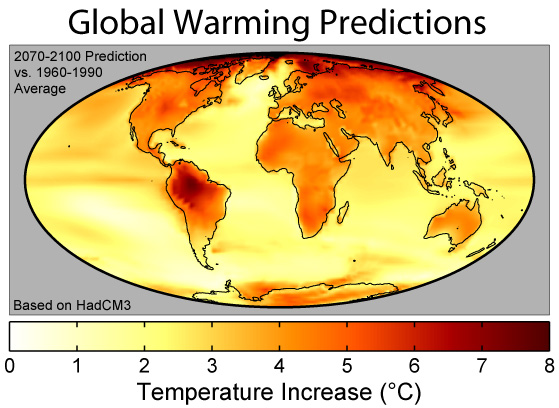
This figure shows the predicted distribution of temperature change due to global warming from Hadley Centre HadCM3 climate model[1]. These changes are based on the IS92a ("business as usual") projections of carbon dioxide and other greenhouse gas emissions during the next century, and essentially assume normal levels of economic growth and no significant steps are taken to combat global greenhouse gas emissions.
The plotted colors show predicted surface temperature changes expressed as the average prediction for 2070-2100 relative to the model's baseline temperatures in 1960-1990. The average change is 3.0°C, placing this model towards the low end of the Intergovernmental Panel on Climate Change's 1.4-5.8°C predicted climate change from 1990 to 2100[2]. As can be expected from their lower specific heat, continents warm more rapidly than the oceans in the model with an average of 4.2°C to 2.5°C respectively. The lowest predicted warming is 0.55°C south of South America, and the highest is 9.2°C in the Arctic Ocean (points exceeding 8°C are plotted as black).
This model is fairly homogeneuous except for strong warming around the Arctic Ocean related to melting sea ice and strong warming in South America related to predicted changes in the El Niño cycle and the possible collapse of the Amazon Rainforest. This pattern is not a universal feature of models, as other models can produce large variations in other regions (e.g. Africa and India) and less extreme changes in places like South America.
References
- ↑ http://www.metoffice.gov.uk/research/hadleycentre/models/modeltypes.html
- ↑ Archive copy. Archived from the original on 2006-04-17. Retrieved on 2006-04-10.
Copyright
This figure was prepared by Robert A. Rohde from publicly available data, and is incorporated into the Global Warming Art project.

|
Baimena duzu dokumentu hau kopiatu, banatu edo/eta aldatzeko GNU Free Documentation License baldintzapean, Free Software Foundationek argitaratutako 1.2 edo ondorengo bertsioan; sekzio aldaezinik gabe, azaleko testurik gabe, eta atzeko azaleko testurik gabe. Lizentziaren kopia dago GNU Free Documentation License izenburudun atalean. |
  
|
Fitxategi hau Creative Commons Attribution-Share Alike 3.0 Unported lizentziapean dago. | |
| ||
| This licensing tag was added to this file as part of the GFDL licensing update. |
Fitxategiaren historia
Data/orduan klik egin fitxategiak orduan zuen itxura ikusteko.
| Data/Ordua | Iruditxoa | Neurriak | Erabiltzailea | Iruzkina | |
|---|---|---|---|---|---|
| oraingoa | 15:43, 10 azaroa 2007 | | 559 × 408 (90 KB) | wikimediacommons>Toony | {{Information |Description=Global_Warming_Predictions_Map |Source=gwart |Date= |Author=GWart |Permission= |other_versions= }} |
Fitxategiaren erabilera
Fitxategi hau darabil ondorengo orri honek:
