Fitxategi hau Wikimedia Commons biltegikoa da, eta beste proiektu batzuetan erabil daiteke.
Behean dago fitxategiaren deskribapeneko orria.
Wikipedia
This formerly was a featured picture on the English language Wikipedia (Featured pictures) and was considered one of the finest images. This is a featured picture on the Persian language Wikipedia (نگارههای برگزیده) and is considered one of the finest images. This is a featured picture on the Malay language Wikipedia (Gambar pilihan) and is considered one of the finest images.
If you think this file should be featured on Wikimedia Commons as well, feel free to nominate it.
If you have an image of similar quality that can be published under a suitable copyright license, be sure to upload it, tag it, and nominate it.
Laburpena
DeskribapenaKeplers supernova.jpg
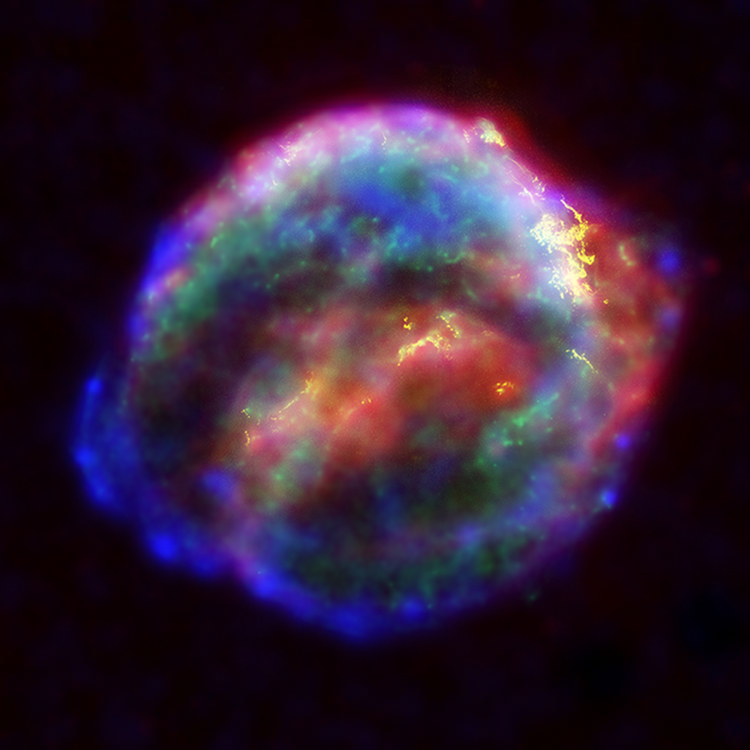
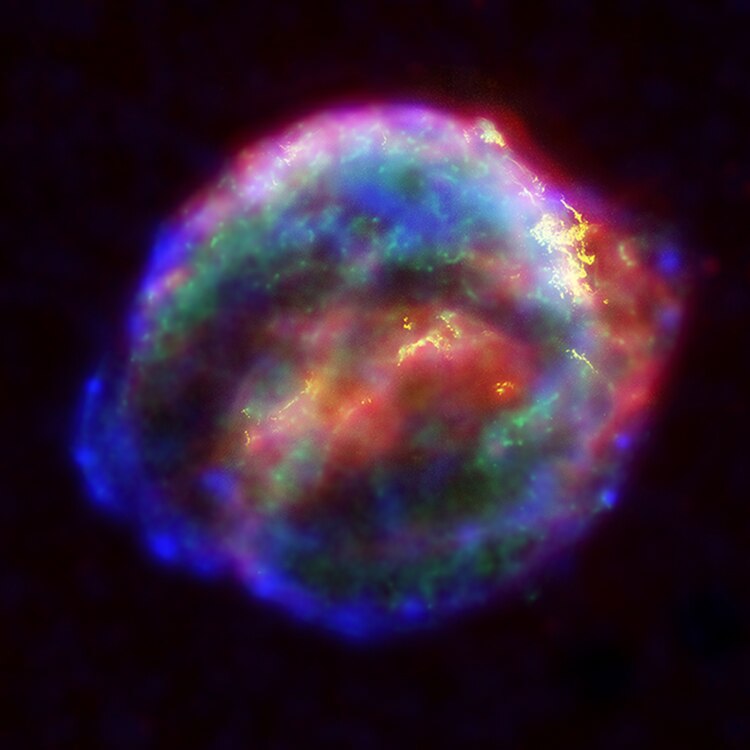
X-ray, Optical & Infrared Composite of Kepler's Supernova Remnant
"On October 9, 1604, sky watchers -- including astronomer Johannes Kepler, spotted a "new star" in the western sky, rivaling the brilliance of nearby planets. "Kepler's supernova" was the last exploding supernova seen in our Milky Way galaxy. Observers used only their eyes to study it, because the telescope had not yet been invented. Now, astronomers have utilized NASA's three Great Observatories to analyze the supernova remnant in infrared, optical and X-ray light." [1]
Color Code (Energy):
Blue: X-ray (4-6 keV), en:Chandra X-ray Observatory, The higher-energy X-rays come primarily from the regions directly behind the shock front.
Green: X-ray (0.3-1.4 keV), en:Chandra X-ray Observatory; Lower-energy X-rays mark the location of the hot remains of the exploded star.
Yellow: Optical, en:Hubble Space Telescope; The optical image reveals 10,000 degrees Celsius gas where the supernova shock wave is slamming into the densest regions of surrounding gas.
Red: Infrared, en:Spitzer space telescope; The infrared image highlights microscopic dust particles swept up and heated by the supernova shock wave.
Data
The Chandra observations were taken in June 2000, the Hubble in August 2003, and the Spitzer in August 2004. [2]
This is a retouched picture, which means that it has been digitally altered from its original version. Modifications: Minor retouching to remove some identifying text in the bottom blackspace, to aid in its use on non-English wikis..
The NASA website hosts a large number of images from the Soviet/Russian space agency, and other non-American space agencies. These are not necessarily in the public domain.
The SOHO (ESA & NASA) joint project implies that all materials created by its probe are copyrighted and require permission for commercial non-educational use. [4]
Add a one-line explanation of what this file represents
Remnant of Kepler's Supernova SN 1604
عکسی از یک سوپرنووا
Kepler süpernovası
Johannes Kepler által 1604. október 9-én észlelt szupernóva maradványa a Hubble, Spitzer és a Chandra űrteleszkóp kompozit felvételén. A kek és zöld színek röntgentartományban, a sárga látható fényben készült, a piros pedig infravörös sugárzás.